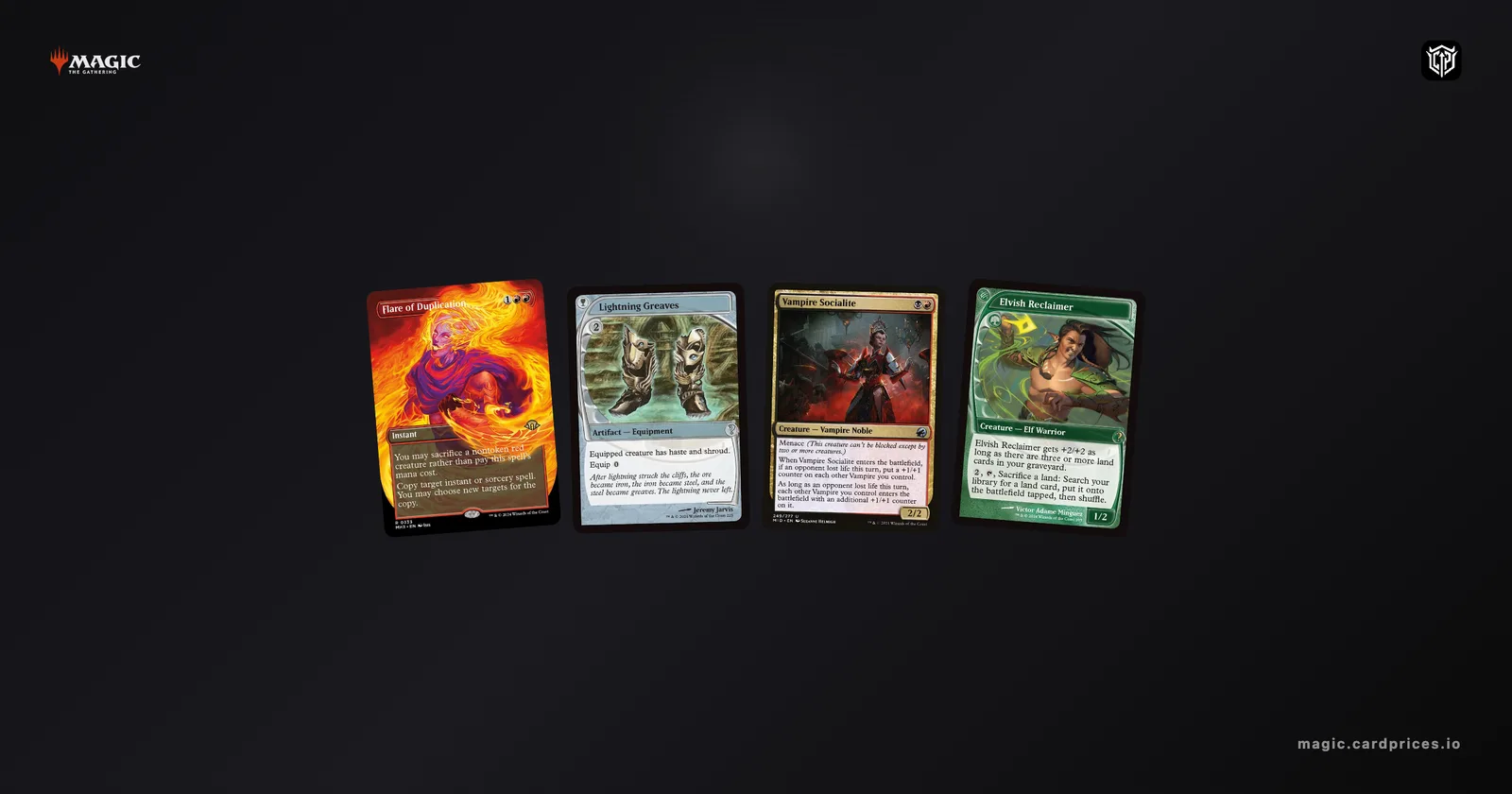
MTG finance had some movement this week worth paying attention to. Flare of Duplication was the headline — up 496% to $37.95 on the week. Whenever something moves that sharply it's worth understanding why before you decide what to do with the information.
Running through the notable movers below, both up and down.
What Went Up
Flare of Duplication (333) — R — up 496%, now $37.95. Commander demand is the most likely driver here — it's the kind of card that shows up across a ton of decks and stays relevant as the format grows.
Lightning Greaves (Future Sight) (225) — U — up 495%, now $21.66. This looks like speculation more than organic demand. Could be correct, could retrace. Worth watching the trajectory over the next week.
Vampire Socialite (249) — U — up 492%, now $29.00. Format-driven increase. When the competitive metagame shifts, these kinds of role-players move before anyone announces anything official.
Elvish Reclaimer (Future Sight) (205) — R — up 471%, now $34.51. The Reserved List status here means supply doesn't change. Any demand spike goes straight to price. This one's not going back to where it was.
Rydia, Summoner of Mist (504) — U — up 464%, now $24.30. Low-supply printing meeting consistent demand. Price discovery is still happening on this one — it may have more room.
What Fell
A few cards gave back ground this week. Reprint risk, format shifts, and rotation pressure all tend to push prices in the same direction.
Flooded Strand (316) — down 91%, sitting at $109.94. Post-spike correction is natural. The question is whether it finds a new floor here or keeps sliding.
Battlefield Forge (139) — down 90%, sitting at $10.87. Reprint in recent product likely explains this. Supply caught up. These declines tend to stabilize once the new copies get absorbed by the market.
Hall of the Bandit Lord (277) — down 75%, sitting at $20.06. Format play has dried up on this one. If a new shell develops that wants it, that changes everything — but for now the downtrend makes sense.
💡 MTG finance rule of thumb
Buying into a spike is almost always wrong. If a card is up 40% on the week, the people who bought at the bottom already made their money. The question now is whether the new price holds — and most of the time, it partially corrects before finding a floor.
